AI Engineer Core Track vs Agentic AI Track: Which Should You Take First in 2026?
Ed Donner’s two AI-engineering courses compared — the Core Track (LLM foundation) vs the Agentic Track (deep agent + MCP). Which to take first, who each suits, and the right order.
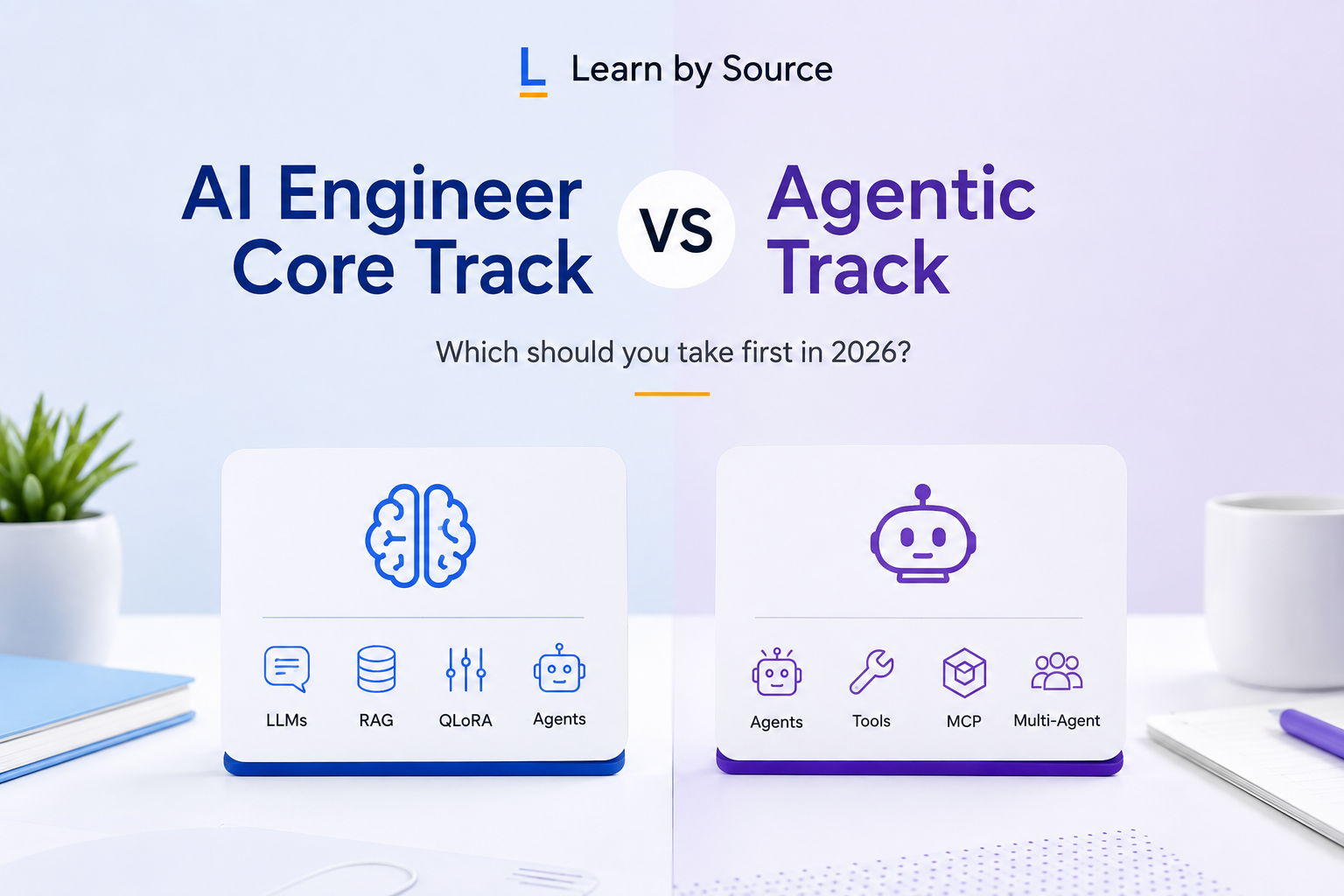
Ed Donner’s AI Engineer Core Track and Agentic Track are two of the most popular ways for developers to break into AI engineering — both his, both rated 4.7 across 40,000+ ratings each, both shipping 8 hands-on projects. So the useful question isn’t which is better. It’s which one to take first.
Same instructor: Ed DonnerBoth rated 4.7★8 projects eachCore = breadth · Agentic = depth
Which should you take first?
For most developers: take the Core Track first, then the Agentic Track. The Core Track gives you the full LLM-engineering foundation — models, RAG, QLoRA fine-tuning, and an introduction to agents. The Agentic Track then goes deep on building production agents with the major frameworks (OpenAI Agents SDK, CrewAI, LangGraph, AutoGen) and the Model Context Protocol (MCP).
Jump straight to the Agentic Track only if you already know LLM fundamentals and RAG and specifically want to specialize in agents.
The order most developers want: Core Track for breadth, then the Agentic Track for depth.
Which track fits where you are now?
The two branches of AI engineering: the Core Track owns LLM applications; the Agentic Track owns agentic systems.
How do the two tracks compare?
| Core Track | Agentic Track | |
|---|---|---|
| Focus | Full LLM pipeline — models, RAG, fine-tuning, intro to agents | Deep agent building + MCP |
| Key tools | LangChain, Chroma, Hugging Face, QLoRA | OpenAI Agents SDK, CrewAI, LangGraph, AutoGen, MCP |
| Level | Intermediate (Python required) | Assumes LLM/agent basics |
| Projects | 8 (RAG worker, QLoRA fine-tune, multi-agent deal-finder…) | 8 (4-agent eng team, browser agent, capstone trading floor: 6 MCP servers, 44 tools) |
| Rating | 4.7 (39,752) | 4.7 (45,798) |
| Length | ~33.5 hours | 21 hrs video · 6-week path |
| Best as | Your first serious AI-engineering course | Your specialization after the foundation |
What does each track actually teach?
The Core Track is breadth. It’s built around four pillars — LLM engineering, RAG, QLoRA fine-tuning, and agents — so you finish able to work across the whole pipeline. It introducesagents but doesn’t go deep on agent frameworks. For the full picture, read our full Core Track review.
The Agentic Track is depth. It picks up where agents get serious: the major frameworks (OpenAI Agents SDK, CrewAI, LangGraph, Microsoft AutoGen), agent design patterns, and MCP — building toward complex multi-agent systems. The capstone has you build a trading floor of four autonomous agents powered by six MCP servers and 44 tools.
The overlap is small and intentional. Both touch “agents,” but the Core Track only opens the door the Agentic Track walks through. Do the Agentic Track first with no foundation and you’ll wire up multi-agent systems without understanding the RAG, fine-tuning, and model-selection choices underneath them.
Editor’s note: Because both are Ed Donner courses with a shared teaching style and project format, taking them in order feels like one continuous curriculum — not two overlapping products. That’s the point of doing Core → Agentic.
One coherent path: Core Track (LLM application engineering) → projects → Agentic Track (agent engineering) → production.
So which is the honest pick?
Core Track → Agentic Track is the natural order: breadth first, depth second. The Agentic Track isn’t a sequel you can safely skip to unless you already have the foundation. If agents are your only goal and you already know LLM basics, starting with the Agentic Track is defensible — but you’ll still want the Core Track’s RAG and fine-tuning later.
Neither course on its own makes you an AI engineer. What gets you hired is the portfolio you build from the 16 combined projects, plus deployment skills (Docker, a cloud platform) that neither course focuses on.
Reality check: “Which first?” matters less than “will you finish and build?” A half-done Core Track beats an owned-but-unwatched pair. Pick one, ship the projects, then move to the next.
Will these courses help you get hired?
Short version: the skills are in demand, but the certificate isn’t what gets you hired — your portfolio is.
- Job market demand — AI and LLM engineering is one of the fastest-growing corners of software hiring. Employers want developers who can put LLMs into production with RAG, retrieval and agents — exactly what these two tracks build — mapping to roles like AI engineer, LLM engineer and applied-AI engineer.
- Certification type & value — both are Udemy courses, so you earn a Udemy Certificate of Completion: a fine personal milestone, but not an accredited or industry-recognized credential, and employers give it little weight. What they assess is evidence you can build — the 8 (or 16 combined) projects, pushed to GitHub and deployed. Ed Donner also runs a free “Proficient AI Engineer” recognition directory for people who demonstrate the skills, a stronger signal than the completion certificate itself.
Before you start: a quick checklist
- Comfortable writing Python? Both tracks assume it — shore that up first if not.
- Already know LLM basics and RAG? If yes, you can begin with the Agentic Track. If unsure, start with the Core Track.
- Have a multi-week block of time? Commit to one track and finish its projects before buying the next.
- Want to try before you pay? Start with a free option below, then decide.
What if you want a free start or a different framework?
Both tracks are paid Udemy courses. If you’d rather start free, or go deep on a single framework, there are strong alternatives:
- Free, vendor-neutral foundations: Andrew Ng’s Agentic AI (DeepLearning.AI).
- Free and hands-on across frameworks: Hugging Face’s AI Agents Course.
- Go deep on one framework: LangChain Academy’s Intro to LangGraph or Multi-Agent Systems with LangGraph.
- A Python-first agents course: AI Agents & Agentic AI with Python.
- Shore up the foundation first: RAG with LangChain.
Next steps
- Read the deep dive: AI Engineer Core Track review
- See the courses: Core Track · Agentic Track
- Compare more options: browse AI & ML courses →