How to Pick the Right AWS Solutions Architect Course (Without Drowning in Options)
Search "AWS Solutions Architect Associate course" and you'll get hundreds of 4.7+ star results. Ratings stopped being a useful filter — here's a framework that actually is one.

Search "AWS Solutions Architect Associate course" and you'll get hundreds of results, all with 4.7+ star ratings and "best of 2026" in the title. That's the problem — ratings have stopped being useful as a filter. Everyone passes the bar. The real question isn't which course is highest-rated, it's which course matches what you're actually trying to become.
So let's skip the ratings race and build a framework you can actually use — then apply it to the SAA-C03 specifically, since it's the most popular AWS cert and the one most people land on this page looking for.
Step 1: Decide Your Goal Before You Decide Your Course
This is the step almost everyone skips, and it's the one that actually matters most. There are really only three goals, and they point to different courses:
- Pass the exam, fast. You need the credential for a job application or a deadline. Go exam-focused.
- Become a genuinely better AWS architect. The exam is secondary; you want real skill. Go hands-on/project-focused.
- Both (the smart default for most people). You want a course that teaches concepts, has you build real things, and preps you for the exam — not one that sacrifices the others.
If you're a software engineer already shipping things — APIs, WordPress sites, AI projects, whatever — and you're cloud-curious rather than cloud-desperate, you're almost always in the third bucket. Don't let a "pass in 2 weeks" sales page talk you into the first one if depth is what you actually want.
Step 2: What a Good Instructor Actually Looks Like
Forget the bio. Look for these specific signals:
- Updates within the last 6–12 months. AWS changes services and exam content constantly; a course from 2023 that hasn't been touched is teaching you yesterday's exam.
- Explains the "why," not just the "what." Anyone can tell you S3 has storage classes. A good instructor tells you why you'd choose Intelligent-Tiering over Glacier for a specific workload — that's the skill that survives past the exam.
- Active Q&A engagement. A flooded, unanswered Q&A section is a red flag regardless of the star rating sitting above it.
Step 3: The Non-Negotiable Checklist
A course worth your money should include:
- ✅ AWS Free Tier labs (you should be building, not just watching)
- ✅ Real-world architecture examples
- ✅ Architecture diagrams
- ✅ Practice exams
- ✅ Downloadable notes/slides
- ✅ Cost optimization discussion
- ✅ Security fundamentals (IAM, VPC) — these show up constantly in both the exam and real jobs
Walk away if a course:spends hours reading AWS documentation out loud, drills only practice-test answers with no concept building, hasn't been updated recently, or never actually demos anything live.
Step 4: Score Candidates With a Real Scorecard
Rating courses on instinct is how you end up persuaded by a flashy thumbnail. Use weights instead:
| Criteria | Weight |
|---|---|
| Instructor quality | 25% |
| Hands-on labs | 20% |
| Updated recently | 15% |
| Practice exams | 15% |
| Real projects | 10% |
| Student reviews | 10% |
| Explanation quality | 5% |
Score each course you're considering out of 10 on each row, multiply by weight, and you'll have an actual number instead of a vibe.
The Four Instructors Everyone Recommends — And How They Actually Differ
For SAA-C03 specifically, four names come up over and over in AWS communities, and each one optimizes for something different:
| Instructor | Best For | Depth | Time | Exam Focus |
|---|---|---|---|---|
| Adrian Cantrill | Becoming a real cloud engineer | ⭐⭐⭐⭐⭐ | 60–70+ hrs | ⭐⭐⭐⭐☆ |
| Stephane Maarek | Fast certification + solid grasp | ⭐⭐⭐⭐☆ | 27–30 hrs | ⭐⭐⭐⭐⭐ |
| Neal Davis | Beginners who like structure | ⭐⭐⭐⭐☆ | 24–30 hrs | ⭐⭐⭐⭐⭐ |
| Andrew Brown | Free, budget learning | ⭐⭐⭐☆☆ | 20–30 hrs | ⭐⭐⭐⭐☆ |
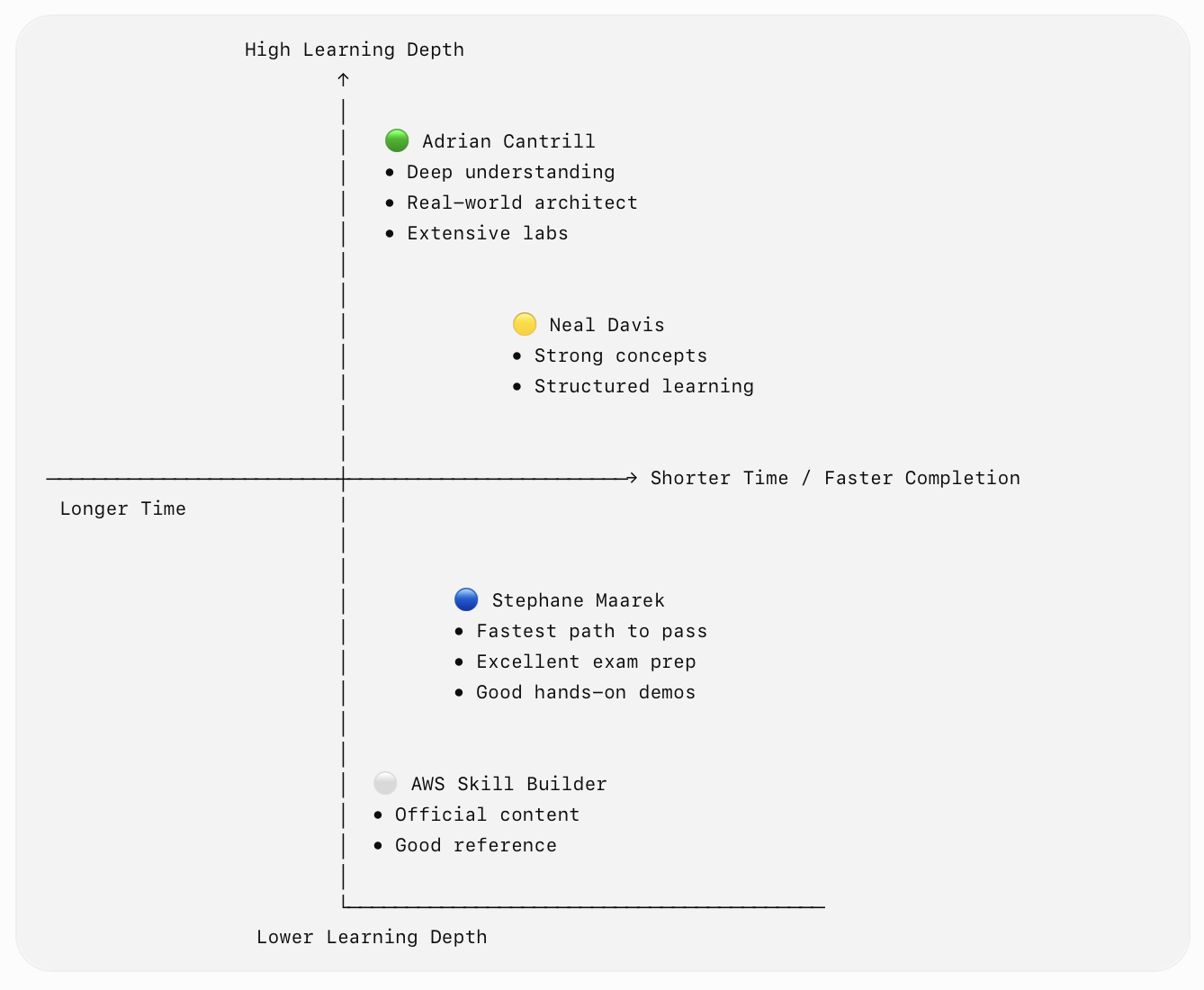
If you plotted these on a depth-vs-time chart, Cantrill sits in the top-left (deepest, longest), Maarek sits closer to the top-right sweet spot (strong depth, much shorter time), Neal Davis sits just below Maarek (great structure, slightly less architectural depth), and the official AWS Skill Builder path sits lower on depth but is free and always current — a good supplement, rarely a good primary course on its own.
So Which One Should You Actually Pick?
| Your situation | Go with |
|---|---|
| Want to become an AWS architect, not just pass | Adrian Cantrill |
| Need certified in 1–2 months | Stephane Maarek |
| Completely new to cloud | Neal Davis or Cantrill |
| Want only official AWS material | AWS Skill Builder |
| On a tight budget | Andrew Brown + Skill Builder |
We've reviewed Stephane Maarek's Ultimate AWS Certified Solutions Architect Associate course in full — it's the most-taken SAA-C03 prep course for a reason, and it's the one we'd point most people toward if "certified within a couple of months" is the actual goal.
The Combination Successful Candidates Actually Use
This is the part most "best course" articles skip: very few people who pass on their first attempt use only one course. The pattern that comes up again and again:
- Primary course — Cantrill or Maarek, depending on your depth-vs-speed goal
- Tutorials Dojo / Jon Bonso practice exams — widely considered the most realistic SAA-C03 practice questions available
- AWS Free Tier labs — building the actual thing, not just watching it built
- Targeted review of weak topics in the final 1–2 weeks before the exam
If you're newer to AWS entirely, it's worth starting even further back — AWS Cloud Practitioner Essentials is the standard, low-risk first step before SAA-C03, and it's free to audit. If your interests lean toward AI workloads on AWS specifically rather than general architecture, our review of AWS Certified AI Practitioner covers that adjacent path.
If You're a Builder, Not Just an Exam-Taker
Here's the honest take: if you already write software and you're cloud-curious because you want to actually useAWS — not just add a credential to LinkedIn — don't pick the 27-hour exam-cram course as your only resource. Pair your primary course with 2–3 real personal projects:
- Host a WordPress site on EC2 or Lightsail instead of shared hosting
- Build a serverless API with Lambda + API Gateway + DynamoDB
- Deploy a small AI/inference app behind a proper VPC and IAM setup
These projects do double duty: they cement what the course teaches, and they're genuinely useful on a resume or portfolio in a way "passed the exam" alone isn't.